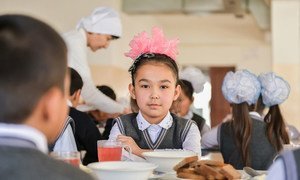
With classrooms closed due to the COVID-19 pandemic, two UN agencies are urging governments to act now to shore up the futures of the 370 million children worldwide who depend on school meals.
The World Food Programme (WFP) and the UN Children’s Fund (UNICEF) fear these young lives will suffer devastating nutritional and health consequences as a result of the crisis.
During #COVID19 school closures, the world's most vulnerable children are missing out on more than education.
For millions of children in fragile countries, school is a place of safety, the promise of a daily meal
, as well as access to
health and nutrition.


“For millions of children around the world, the meal they get at school is the only meal they get in a day. Without it, they go hungry, they risk falling sick, dropping out of school and losing their best chance of escaping poverty”, said David Beasley, the WFP Executive Director.
“We must act now to prevent the health pandemic from becoming a hunger catastrophe and to ensure that no one is left behind.”
School as a safety net
School meals are particularly critical for girls, according to the two partners. Some parents in poor countries will send their daughter to school based on the promise of her getting a meal there. This in turn allows girls to escape domestic drudgery or even forced early marriage.
School is also more than a place of learning, as children in poor countries often benefit from health services delivered there, such as vaccinations and de-worming.
“For many children it is a lifeline to safety, health services and nutrition”, said Henrietta Fore, UNICEF Executive Director.
“Unless we act now – by scaling up lifesaving services for the most vulnerable children – the devastating fallout caused by COVID-19 will be felt for decades to come.”
Looking to the future
WFP and UNICEF are working with governments to support children now out of school, in line with a recent report from the UN Secretary-General which highlighted the pandemic’s impact on school meals, which are often the only reliable daily intake children can expect to receive.
They are providing children in nearly 70 countries with take-home rations, vouchers or cash transfers as an alternative.
Coronavirus Portal & News Updates
Readers can find information and guidance on the outbreak of the novel coronavirus (2019-nCoV) from the UN, World Health Organization and UN agencies here.For daily news updates from UN News, click here.
In the coming months, the UN agencies will also assist governments in ensuring that children will benefit from school meals and health programmes when classrooms re-open, thus providing an incentive for parents to send their children back to school.
However, the partners will need $600 million to carry out this work, which initially will focus on 10 million children in 30 low-income or fragile countries.
Comments
Post a Comment