G-20 summit provides chance to rally strongly against coronavirus threat: UN chief
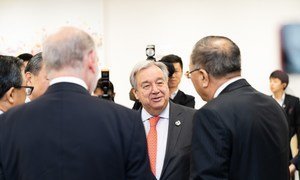
UN Secretary-General António Guterres at the G-20 summit in Japan in 2019. He is shown at the Climate Change Trilateral Meeting with HE Mr. Jean-Yves Le Drian, Foreign Minister of France and HE Mr. Wang Yi, Foreign Minister of China
24 March 2020
The COVID-19 crisis presents an "extraordinary opportunity" for the world’s leading economic forum to respond to the numerous threats the disease poses to people everywhere, the UN Secretary-General has said.
In a letter to the members of the Group of 20 industralized powers (G-20), António Guterres welcomed their decision to convene an emergency virtual summit on the pandemic, which has already affected health, education and economies worldwide.
"COVID-19 will require a response like none before -- a ‘war-time’ plan in times of human crisis", he wrote on Monday.
"The G-20 leadership has an extraordinary opportunity to step forward with a strong response package to address the various threats of COVID-19. This would demonstrate solidarity with the world’s people, especially the most vulnerable".
Coronavirus Portal & News Updates
Suppress the virus
Mr. Guterres recommended three areas for discussion and decision-making at the meeting, due to be held on Thursday.
Topping his list is the need for coordinated action to suppress the virus through "an articulated response mechanism" guided by the World Health Organization (WHO).
"Such a mechanism would strengthen the global response and provide countries with stronger capabilities to stop transmission: test, trace, quarantine, treat the sick and coordinate measures to restrict movement and contact. It would also help enhance scientific collaboration in the search for a vaccine and therapeutic treatment", he said.
Additionally, he called for increased procurement of medical and protective equipment, particularly for developing countries, and offered up the UN’s global supply network for this purpose.
G-20 leaders were also asked to ban tariffs and remove restrictions on cross-border trade that affects the deployment of medical equipment, medicines and other essential goods.
"And I am encouraging the waiving of sanctions imposed on countries to ensure access to food, essential health supplies, and COVID-19 medical support. This is the time for solidarity not exclusion", the Secretary-General added.
Stimulus package for developing countries
For his second point, Mr. Guterres previewed the social and economic impact of the pandemic, which is likely to be in the trillions of dollars. He urged the G-20 to launch a large-scale stimulus package for developing countries.
"Unlike 2008, this is not a banking crisis", he said. "While the liquidity of the financial system must be guaranteed, we need to focus on people — families, low-wage workers, small and medium enterprises and the informal sector. Important steps have already been taken by developed countries in this direction. This must be scaled up".
Furthermore, developing economies also will require a support package that could include trade credits, liquidity lines and help in accessing concessional financing.
‘Recover better’ through sustainable development
Looking further ahead, the UN chief underlined the need to "recover better" through more inclusive and sustainable development models. The pandemic has served as a "stark reminder" of humanity’s common fate and the need to invest in critical public services and social protection systems.
He reminded G-20 leaders of the agreed global framework for action through the 2030 Agenda for Sustainable Development and the Paris Agreement on Climate Change.
"We must ensure that the recovery strategy out of this crisis keeps us on track towards these longer-term objectives, building a sustainable and inclusive economy", he said.
Mr. Guterres also urged G-20 nations to "contribute generously" to the COVID-19 humanitarian appeal he will launch on Wednesday, mainly focused on 40 countries where health systems are most vulnerable.
C
Comments
Post a Comment