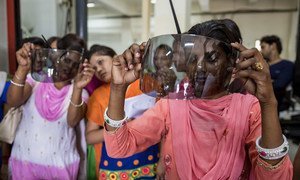
Women in India are being trained in plastic engineering.
10 February 2020
Fewer than 30 per cent of the world’s scientific researchers are women: that’s just one of the statistics showing how many challenges remain for women and girls in the scientific field, as the world marks the International Day of Women and Girls in Science, on Tuesday.
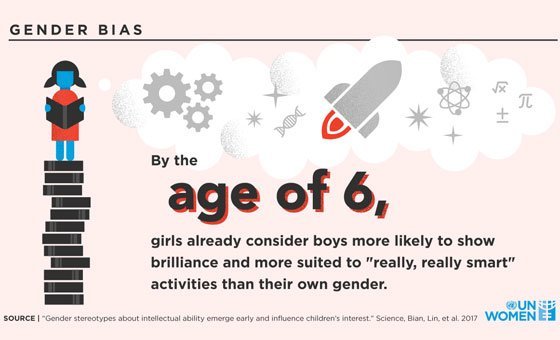
Pledging to end the gender imbalance in science, the UN Secretary-General António Guterres said in his message for the Day that “dismantling gender stereotypes” was an essential step.
He highlighted the fact that “girls and boys perform equally well in science and mathematics, but only a fraction of female students in higher education choose to study sciences” and called for more supportive career development for women scientists and researchers.
Science can bring life-changing benefits
In her statement issued to mark the Day, UN Women’s Executive Director, Phumzile Mlambo-Ngcuka, reinforced that message, specifying that “science and innovation can bring life-changing benefits, especially for those who are furthest behind – such as women and girls living in remote areas, the elderly and people with disabilities”.



Highlighting also the importance of science for decent work and jobs of the future, including in the green economy – essential to tackle the climate crisis - Ms. Mlambo-Ngcuka said that there was a clear need to “break gender stereotypes that link science to masculinity”.
Paid less, published less
According to the UN Educational, Scientific and Cultural Organization (UNESCO), women in science, technology, engineering and maths (STEM) are published less, paid less for their research and do not advance as far as men in their careers.
UNESCO data from 2014-2016 shows that globally, female students’ enrolment is particularly low in information and communications technology (ICT), where women represent only three per cent, and natural science, mathematics and statistics, where the figure is five per cent.
“If we are to be able to address the enormous challenges of the 21st Century – from climate change to technological disruption - we will need to rely on science and the mobilization of all our resources”, said UNESCO chief Audrey Azoulay.
“It is for this reason that the world must not be deprived of the potential, the intelligence, or the creativity of the thousands of women who are victims of deep-seated inequality and prejudice.”
The International Day was established in 2015, following the adoption of a General Assembly resolution, signalling the international community’s interest in achieving equality and gender-parity in science for sustainable development, and recognizing that full access and participation in STEM subjects is imperative for the empowerment of women and girls.
Window of opportunity
Marking the 25th anniversary of the Beijing Declaration and Platform for Action, a roadmap for the rights of women and girls, 2020 offers a fresh opportunity for progress towards gender parity.
The UN Secretary-General said the anniversary was a chance to “bring new urgency to promoting women’s and girls’ access to science education, training and jobs”.
The UN Women’s Generation Equality campaign aims to accelerate gender equality actions and mark the 25th anniversary of the Beijing Declaration and Platform for Action.
With six diverse Action Coalitions to tackle the unfinished business of gender equality, one focus of the campaign is on “Technology and Innovation for Gender Equality”, which aims to “catalyse action for game-changing approaches that provide new opportunities to women and girls, while addressing barriers to connectivity, digital inclusion and digital equality”.
UN Women’s Phumzile Mlambo-Ngcuka added that “Generation Equality was also a chance to ensure that the business community, including those in the STEM sectors, has a stake in and a responsibility for gender equality and women’s empowerment in the workplace, marketplace and community”.
Courtesy:UN News
Comments
Post a Comment