By installing solar home systems in the poorest villages, write Sam Geall and Shen Wei, China hopes to boost the incomes of 200 million households
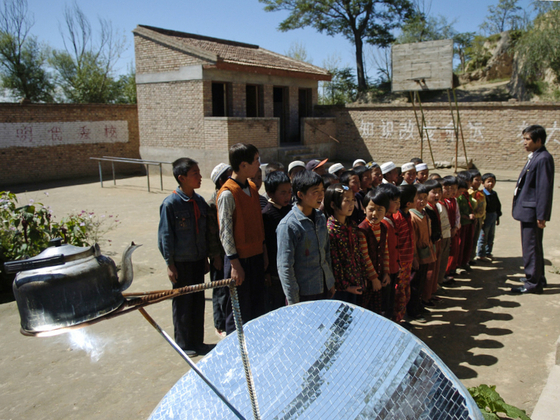
China's National Energy Administration plans to install rooftop or micro solar energy systems across the country's poorest villages (Image by Liang Qiang / World Bank)
China is fast becoming a green energy superpower, leading the world in investment and installation of low-carbon technology. The most widely discussed drivers of this renewables surge include the desire to cut greenhouse gas emissions, boost energy security and catch up with, or overtake, industrialised countries in technological innovation.
But a recent policy initiative has highlighted another, often overlooked, motivation: tackling poverty.
China still has more than 70 million people living below the poverty line, according to official statistics, mainly in remote rural areas with limited energy access. President Xi Jinping has said he wants to get this number to zero by 2020, and since late last year government institutions have been setting out plans to meet this target.
Among them is the National Energy Administration (NEA), which is championing solar photovoltaics (PV) in particular as a tool for poverty reduction. In April, it released a plan to install rooftop or micro solar energy systems in the poorest villages and counties across China, allowing residents to generate electricity for their own use and make money by selling surplus energy back to the grid. The scheme is expected to help 200 million households generate over 3,000 yuan each in extra income every year.
It could also help the NEA tackle structural problems in the distributed solar market, which it considers increasingly important in the face of a faltering economy. China’s solar PV market has taken off, with total installed capacity reaching 43 gigawatts (GW) in 2015, up by 15 GW in a single year. But it is still unable to absorb the country’s production capacity, which in 2015 may have been as high as 45 GW. Already curtailments, where electricity doesn’t reach the grid, are a daily reality in many places. And the problem is set to get more serious as the economy slows further and demand slumps.
With the future uncertain for large, grid-connected solar farms – the major driver of growth to date – energy regulators have turned their focus towards distributed systems. This sector has so far fallen well short of official installation targets, mainly due to problems around grid connectivity and rules on ownership and financing. But with the high-level political focus on poverty eradication, the NEA now has an opportunity to address these obstacles and advance their goal of promoting distributed solar systems.
Challenges
As with many well-intentioned policy plans in China, however, there are questions around implementation and long-term benefits. One concern is finance. The total bill may be as high as 30 billion yuan (US$4.5 billion) over the next five years and it is not entirely clear where this will come from. Most solar projects intended for poverty alleviation are financed either by the government or corporate donations. Policy banks, such as the Agricultural Development Bank of China or the China Development Bank (CDB), promise concessional loans but are limited in their capacity if other commercial finance remains reluctant to join – as it has to date.
The quality of the projects is also uncertain. Benefitting poor households in the long run depends on the durability of rooftop and micro-grid systems and the capability to sell surplus electricity to the grid. This means significant technical and political challenges, as villages and counties confront monopolistic grid companies with whom they have no negotiating leverage. Some villagers fail to see the long-term value of the solar panels on their roofs and simply sell them.
Mismatched policies
The NEA’s push for distributed solar energy also comes at a point where uptake of off-grid solar PV systems has fallen in China. The Chinese government used to support the use of off-grid technologies for pastoralist and other remote communities through the Brightness Programme and Renewable Energy Development Project, the latter of which sold more than 400,000 solar home systems benefitting two million individuals in north-western China from 2002 to 2007. But the policy emphasis has since shifted towards grid-based electrification.
Even for nomads who have taken advantage of government resettlement programmes and been connected to the grid, daily life may still require off-grid solar energy solutions – particularly during the summer months when many work as herders or collect “caterpillar fungus” on the grasslands. By contrast, much of the emphasis in China’s latest Five-Year Plan seems to be on the development of solar resources in northwest China in the form of large-scale, ground-mounted plants connected to demand centres in eastern cities via ultra-high-voltage transmission.
This suggests a deep-rooted mismatch between China’s industrial policies and development targets. Renewable energy in China has typically been promoted by industrial policy, which emphasises supply-side expansion in the form of technology, manufacturing capacity and so on. China has less experience focusing on the demand side — and, in this case, on poor households and communities. The challenge is to find real synergies between China’s ambition to be a green energy superpower and its stated goal of eliminating poverty.
But a recent policy initiative has highlighted another, often overlooked, motivation: tackling poverty.
China still has more than 70 million people living below the poverty line, according to official statistics, mainly in remote rural areas with limited energy access. President Xi Jinping has said he wants to get this number to zero by 2020, and since late last year government institutions have been setting out plans to meet this target.
Among them is the National Energy Administration (NEA), which is championing solar photovoltaics (PV) in particular as a tool for poverty reduction. In April, it released a plan to install rooftop or micro solar energy systems in the poorest villages and counties across China, allowing residents to generate electricity for their own use and make money by selling surplus energy back to the grid. The scheme is expected to help 200 million households generate over 3,000 yuan each in extra income every year.
It could also help the NEA tackle structural problems in the distributed solar market, which it considers increasingly important in the face of a faltering economy. China’s solar PV market has taken off, with total installed capacity reaching 43 gigawatts (GW) in 2015, up by 15 GW in a single year. But it is still unable to absorb the country’s production capacity, which in 2015 may have been as high as 45 GW. Already curtailments, where electricity doesn’t reach the grid, are a daily reality in many places. And the problem is set to get more serious as the economy slows further and demand slumps.
With the future uncertain for large, grid-connected solar farms – the major driver of growth to date – energy regulators have turned their focus towards distributed systems. This sector has so far fallen well short of official installation targets, mainly due to problems around grid connectivity and rules on ownership and financing. But with the high-level political focus on poverty eradication, the NEA now has an opportunity to address these obstacles and advance their goal of promoting distributed solar systems.
Challenges
As with many well-intentioned policy plans in China, however, there are questions around implementation and long-term benefits. One concern is finance. The total bill may be as high as 30 billion yuan (US$4.5 billion) over the next five years and it is not entirely clear where this will come from. Most solar projects intended for poverty alleviation are financed either by the government or corporate donations. Policy banks, such as the Agricultural Development Bank of China or the China Development Bank (CDB), promise concessional loans but are limited in their capacity if other commercial finance remains reluctant to join – as it has to date.
The quality of the projects is also uncertain. Benefitting poor households in the long run depends on the durability of rooftop and micro-grid systems and the capability to sell surplus electricity to the grid. This means significant technical and political challenges, as villages and counties confront monopolistic grid companies with whom they have no negotiating leverage. Some villagers fail to see the long-term value of the solar panels on their roofs and simply sell them.
Mismatched policies
The NEA’s push for distributed solar energy also comes at a point where uptake of off-grid solar PV systems has fallen in China. The Chinese government used to support the use of off-grid technologies for pastoralist and other remote communities through the Brightness Programme and Renewable Energy Development Project, the latter of which sold more than 400,000 solar home systems benefitting two million individuals in north-western China from 2002 to 2007. But the policy emphasis has since shifted towards grid-based electrification.
Even for nomads who have taken advantage of government resettlement programmes and been connected to the grid, daily life may still require off-grid solar energy solutions – particularly during the summer months when many work as herders or collect “caterpillar fungus” on the grasslands. By contrast, much of the emphasis in China’s latest Five-Year Plan seems to be on the development of solar resources in northwest China in the form of large-scale, ground-mounted plants connected to demand centres in eastern cities via ultra-high-voltage transmission.
This suggests a deep-rooted mismatch between China’s industrial policies and development targets. Renewable energy in China has typically been promoted by industrial policy, which emphasises supply-side expansion in the form of technology, manufacturing capacity and so on. China has less experience focusing on the demand side — and, in this case, on poor households and communities. The challenge is to find real synergies between China’s ambition to be a green energy superpower and its stated goal of eliminating poverty.
courtesy chinadialogue
Comments
Post a Comment